
Fauquier County Court Records After Arrest
The arrest-to-court path in Fauquier has three record systems. The Sheriff's ADC keeps custody and booking information. Virginia courts maintain criminal case records. The Commonwealth's Attorney handles prosecution decisions for traffic and criminal offenses that occur in Fauquier County. The jail does not file the court case. It records a person in custody and can release limited current-charge information by phone.
For custody and booking information, use Fauquier County jail inmate records. For booking photos, use the Fauquier County jail mugshots page. For court records after a jail arrest, start with Virginia court case information and, when needed, the Fauquier Circuit Court Clerk record room.
Find Court Records After Arrest
The county's own "My Court Case" page routes users to Virginia court case information. The statewide Virginia courts case information page describes the General District and Circuit case lookup paths. Fauquier arrests may appear first in General District Court, while felonies can later move toward Circuit Court through certification or indictment.
- Open the Virginia courts case information page or the General District Court case information system.
- Search by defendant name, case number, or hearing date when the portal allows that path.
- Open the case and read each charge, court, status, hearing event, and disposition field.
- Check whether a felony moved to Circuit Court through certification or indictment.
- For older Circuit Court records, use the Fauquier Circuit Court Clerk record room instructions.
The Virginia Judiciary OCIS landing page and court case portals may require JavaScript. They are case-status tools, not official statewide criminal-history reports. For official criminal-history checks, use the Virginia State Police process rather than jail or court web pages.
The Virginia court case-status page is the statewide starting point for court records following a Fauquier County arrest.
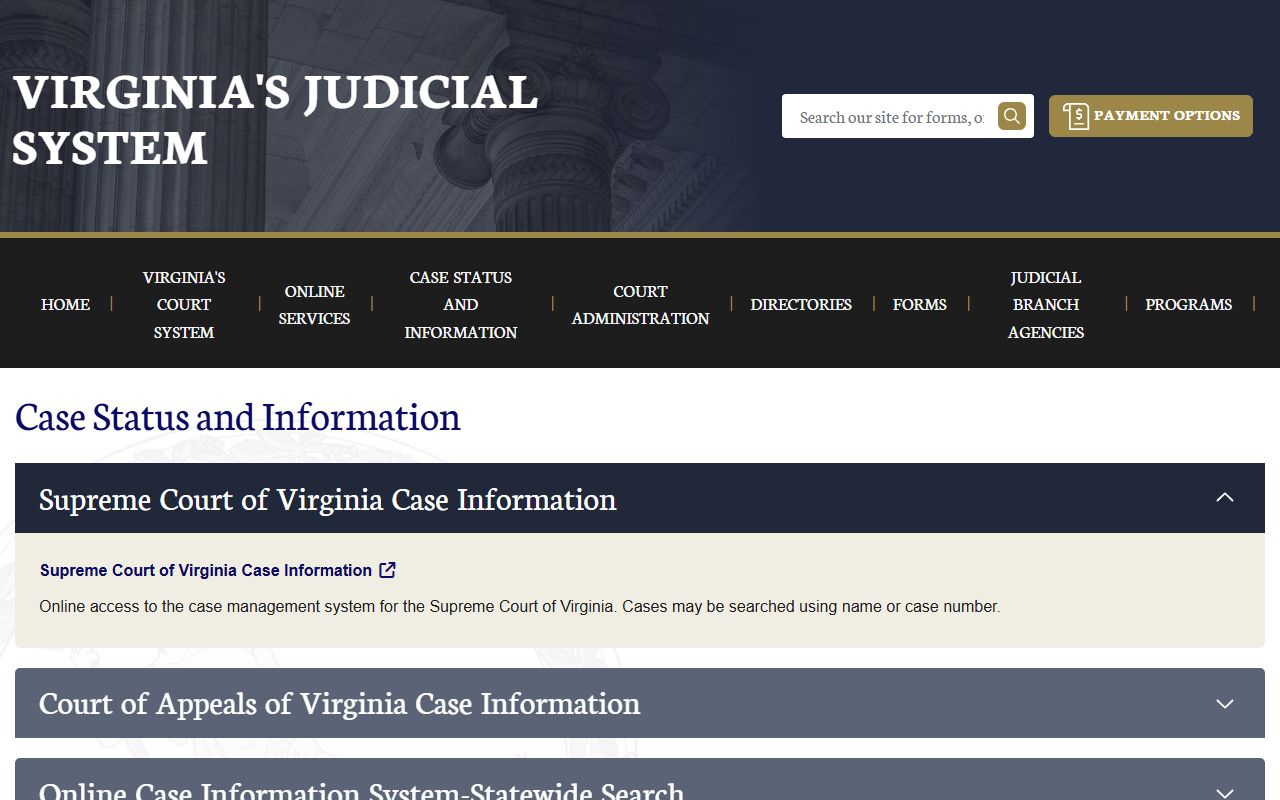
Use it to choose the correct court search path after a jail booking becomes a filed case.
Charging Documents After Arrest
Booking charges can appear before the final prosecutor-filed charges are settled. A complaint, information, warrant, or indictment may start or reshape the court record. In Virginia, the Commonwealth's Attorney is the prosecutor, not a district attorney. That office can amend, reduce, dismiss, or nolle prosequi charges, and felonies can move toward Circuit Court by certification or indictment.
| Document | What It Does | Common Fauquier Use |
|---|---|---|
| Complaint or warrant | Starts the charge path after an arrest or sworn accusation. | Often tied to General District Court or magistrate process. |
| Information | Prosecutor-filed charging document in eligible cases. | Shows the formal charge chosen by the Commonwealth's Attorney. |
| Indictment | Grand-jury charge that moves a felony into Circuit Court. | Used for serious felony prosecution in Circuit Court. |
Fauquier Charge Status Terms
Court records after an arrest can change as the case moves. A jail current charge may not match the final charge in court. Look at the most recent court entry, not only the booking information, when checking status.
| Status | What It Means |
|---|---|
| Pending | The case is open and has not reached final disposition. |
| Amended | The charge wording, code, or level changed. |
| Reduced | The charge moved to a lesser offense or lower level. |
| Dismissed | The charge ended without a conviction on that count. |
| Nolle prosequi | The prosecutor declined to proceed, though expungement may still require a court process. |
| Convicted | A guilty plea, finding, or verdict was entered. |
| Certified or indicted | A felony moved toward Circuit Court review or prosecution. |
Bond Orders After Fauquier Arrest
Bond connects the jail record to the court record. The Fauquier ADC page says bonding is available 24 hours per day, seven days a week when an inmate is eligible. Cash is posted directly with the magistrate or court. Property bond requirements should be confirmed with the local magistrate. Private bail bondsmen may be used, but Sheriff's Office employees are not allowed to recommend a bonding company.
| Bond Type | How It Works |
|---|---|
| Cash bond | Money is posted directly with the magistrate or court if allowed. |
| Property bond | Property secures release; requirements must be checked with the magistrate. |
| Private surety | A licensed bondsman posts bond under a private agreement. |
| Recognizance | Release on promise and conditions, if ordered by the court or magistrate. |
| No-bond hold | Release is not available through ordinary posting, or another hold blocks release. |
Warrants and Fauquier Arrest Records
No official searchable Fauquier Sheriff's active-warrant database was found in the source pass. The Sheriff's Civil Process/Court Security division handles court papers, warrants, extraditions, and court security. The 2025 Annual Report says Civil Process entered 2,152 arrest warrants, made 798 arrests, handled 31 extraditions, and entered 978 protective orders in 2025.
For a warrant-related court record, search Virginia court case information by name or case number, contact the relevant court clerk, or use the Sheriff's records/FOIA channel. If a warrant has been executed and the person is booked, the ADC can release current-inmate name, current charges, court of jurisdiction, and bonding information.
Charges Versus Convictions
Being arrested, booked, or charged is not the same as being convicted. A charge is an accusation or filed count. A conviction is a final guilty plea, finding, or verdict. Court records after a jail arrest should be read through that lens, especially when a booking charge was later amended, reduced, dismissed, or not prosecuted.
| Charge | Conviction | |
|---|---|---|
| Stage | Filed accusation or count | Final guilty outcome |
| Where seen | Jail record and court case | Court disposition |
| Can change | Yes, by amendment, reduction, dismissal, or nolle prosequi | Changes only through later court action |
| Background use | Not proof of guilt | May still require official, lawful background-check channels |
Sealed Expunged Arrest Records
Code of Virginia 19.2-392.2 governs expungement of eligible police and court records. Virginia law also restricts disclosure of expunged and sealed records. A dismissal or nolle prosequi does not always erase public visibility by itself. A separate court process may be needed.
| Sealed | Expunged | |
|---|---|---|
| Public visibility | Hidden from ordinary public access | Removed from public access under court order |
| Government access | May remain available in limited lawful settings | Very limited and controlled by law |
| Common trigger | Statutory sealing or court order | Eligible dismissal, acquittal, nolle prosequi, or mistaken identity |
| Where handled | Court and records custodian | Court and records custodian |
Restricted Fauquier Court Records
Some records are not available through ordinary court or jail lookup. Juvenile records, sealed or expunged records, victim or witness details, and active investigative material can be withheld or restricted. Virginia FOIA also distinguishes routine adult booking photos from criminal investigative files. Use the originating court, clerk, or Sheriff's records office for case-specific access questions.
Important: Court and jail lookups are not consumer reports and cannot be used for FCRA-regulated screening decisions.